Why Punks Love Pirates: Skulls, Radio and the Anti-Authority Myth
Punk has always had a magpie streak. It nicks symbols the way it nicks chords, and few symbols have been nicked more often than the pirate. The skull and crossbones turns up on leather jackets, record sleeves, squat walls and festival flags. Pirate radio gave the early punk and reggae scenes a way onto the airwaves. And in Hamburg, a particular skull has become a local badge of honour. None of this is an accident. The pirate is a ready-made anti-authority myth, and punk has never been shy about recycling those.
The Jolly Roger: a logo for outlaws
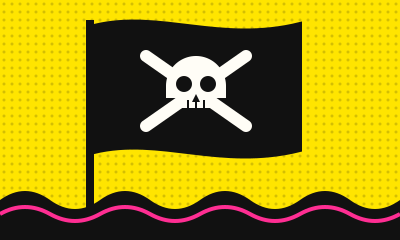
The Jolly Roger is one of the most efficient logos ever designed. A skull, a couple of crossed bones, and everyone knows what it means: we are not on your side, and we are not asking permission. Punks borrowed it for the same reason bikers and football firms did. It is cheap to stencil, easy to draw badly on a wall, and it reads at a distance. It also carries a useful ambiguity. The historical pirate was a violent criminal, but the popular myth has him as a rough democrat, a man who opted out of the navy and the merchant fleet and made his own rules. That tension is exactly what punk wanted. The Jolly Roger lets you look dangerous without having to explain yourself.
The flag’s origins are murky, and anyone who tells you they know exactly where the name comes from is probably selling something. What matters is that by the time punk picked it up, the skull and crossbones already meant rebellion in the popular imagination. It was a symbol waiting for a safety pin.
Pirate radio and the politics of the dial
Pirate radio is the other great pirate inheritance. In Britain, offshore stations in the 1960s showed that you could broadcast without a licence and that people would listen. By the late 1970s, land-based pirate stations were playing punk and reggae that the mainstream wouldn’t touch, and the DIY ethic of setting up a transmitter in a tower block fitted punk’s self-reliance perfectly. You didn’t need a studio. You needed a record player, a tape deck and the nerve to keep moving.
The same logic shows up elsewhere. In Italy, Radio Alice and similar free radio projects were tied to the autonomous left and to punk-adjacent scenes. In the Netherlands and Germany, pirate and free stations did similar work. The details differ from country to country, and it is easy to over-romanticise, but the principle was consistent: the airwaves belong to whoever is brave enough to use them. Calling that “piracy” was the authorities’ word, and punk wore it as a compliment.
Hamburg’s skull: St. Pauli and the Totenkopf
The skull most associated with a punk-adjacent scene is probably the one from Hamburg’s St. Pauli district. The FC St. Pauli football club, based at the Millerntor, has used a skull and crossbones as a fan symbol for decades, and it has spread far beyond football. You see it on T-shirts, patches and tattoos across the punk and alternative scenes in Germany and beyond. The club itself has a long association with left-wing fan culture, anti-fascist organising and the kind of politics that sit comfortably next to punk.
It is worth being careful here. The St. Pauli skull is not a punk logo, and it did not start as one. It is a fan symbol that punk adopted because it fitted. But the fit is good. The skull says the same thing the Jolly Roger says, only with a local accent: this is our patch, we are not moving, and we are not impressed by authority. If you want to dig into the club’s history and the surrounding district, the official club site is the place to start.
The pirate as anti-authority myth
The deeper reason punks love pirates is that the pirate is a myth about refusing work. The historical pirate ship, whatever else it was, was an alternative to the navy and the merchant marine: a place where you might get a share of the takings instead of a wage, and where the captain’s power was, in some crews, limited by written articles. Historians argue about how democratic pirate ships really were, and you should treat the romantic version with suspicion. But the myth is powerful precisely because it imagines a society organised against the grain of the state.
Punk has always been drawn to that. The dole, the squat, the self-released single, the tour booked by phone from a bedsit: these are all small acts of piracy against an economy that would rather you stayed put. The pirate is the patron saint of the person who decides to do it anyway. That is why the skull keeps coming back, and why it means something slightly different every time.
Pirate-themed punk and folk
The musical results are mixed, as you’d expect. On the punk side, the skull is mostly a visual and lyrical motif rather than a genre. Bands have used pirate imagery for its swagger and its menace, and the look has fed into everything from street punk to crust. The folk side is more literal. The maritime folk tradition is full of songs about sailors, wreckers and pirates, and folk-punk bands have long raided that repertoire. Sea shanties, work songs and broadside ballads sit naturally next to punk’s own tradition of songs you can shout in a room with a fiddle and a drum.
There is a whole strand of pirate-themed folk and folk-rock, some of it good, some of it closer to fancy dress. The best of it keeps the roughness. A shanty sung by people who actually work for a living sounds different from one sung by a themed bar band, and punk has always known the difference. If you want to explore the folk end, Bandcamp is a good place to find small labels and self-released records, and Discogs is useful for tracking down the obscure stuff.
What the skull is for
None of this means punks invented the pirate, or that every skull patch is a political statement. Sometimes a skull is just a skull. But the pattern is real, and it tells you something about what punk values: independence, refusal, a bit of theatre, and a healthy disrespect for anyone who claims to own the airwaves, the streets or the sea. The pirate is a useful lie, and punk has always been good at useful lies. Long may the flag keep flying, badly drawn and slightly the wrong shape, on a wall near you.
FAQ
Why do punks use the skull and crossbones?
The Jolly Roger is cheap to stencil, easy to draw badly on a wall, and reads at a distance as a sign of rebellion. It also carries a useful ambiguity: the historical pirate was a violent criminal, but the popular myth portrays him as a rough democrat who made his own rules, which fits punk's anti-authority stance.
What is the connection between punk and pirate radio?
In Britain, offshore stations in the 1960s showed that unlicensed broadcasting could reach listeners, and by the late 1970s land-based pirate stations were playing punk and reggae that the mainstream ignored. The DIY ethic of setting up a transmitter fitted punk's self-reliance, and calling it 'piracy' was the authorities' word, which punk wore as a compliment.
What is the St. Pauli skull and why is it associated with punk?
The skull and crossbones is a fan symbol of Hamburg's FC St. Pauli football club, based at the Millerntor, and the club has a long association with left-wing fan culture and anti-fascist organising. It is not a punk logo and did not start as one, but punk adopted it because it fits the same anti-authority message with a local accent.
Did punks invent pirate-themed music?
No. On the punk side, the skull is mostly a visual and lyrical motif rather than a genre, while the folk side draws on the maritime folk tradition of songs about sailors, wreckers and pirates. Folk-punk bands have long raided that repertoire, and sea shanties and work songs sit naturally next to punk's tradition of songs you can shout in a room.