Punk symbols and what they mean
Punk’s most recognisable symbols are a mix of borrowed politics, cheap hardware and inside jokes. The safety pin came from fetish shops and high-street fashion, the circle-A from the anarchist movement, the Crass logo from a stencil at Dial House, the Black Flag bars from a designer’s shorthand, and the X on the hand from a Los Angeles venue’s age policy. None of them were invented in a vacuum, and a few have been misread since.
Where did the safety pin come from?
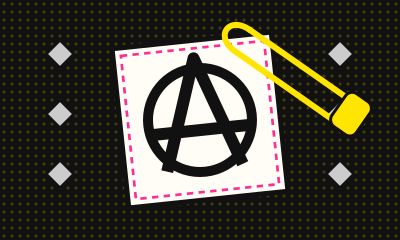
The safety pin is the oldest and most literal punk symbol: a piece of cheap metal used to hold torn clothes together. It appeared in London punk styling around 1976, worn as jewellery and used to pin T-shirts, jackets and trousers. Vivienne Westwood and Malcolm McLaren’s shop SEX sold fetish and bondage clothing, and safety pins fitted the aesthetic: sharp, industrial and available from any stationer. The pin was never a political symbol in the way the circle-A was. It meant DIY, improvisation and a refusal to buy new clothes. It also had a practical use, which is why it survived longer than most punk fashions. If you are building a jacket, see our guide to making a punk battle jacket that actually lasts.
What does the circle-A mean?
The circle-A is the most widely used anarchist symbol: a capital A inside a circle. The A stands for anarchy; the circle stands for order. It was used by anarchist movements long before punk existed. Punk bands adopted it in the late 1970s and 1980s, particularly in the anarcho-punk scene around Crass, Conflict and their labelmates. It appeared on record sleeves, patches, flyers and stencils. The symbol is not punk-specific, and it is worth knowing that when you wear it: it is a political statement, not a fashion logo.
Who designed the Crass logo, and what does it mean?
The Crass logo is a stencilled circular emblem containing a cross, a snake coiled around it and other motifs. It was designed by members of Crass at Dial House in Essex in the late 1970s. The band used it on records, flyers and stencils, and it became a shorthand for anarcho-punk as a whole. The snake and cross have been interpreted as a rejection of Christian authority and a nod to the serpent in the Garden of Eden. For more on the band and the scene, see our piece on Crass, Dial House and the birth of anarcho-punk.
What is the anti-Nazi symbol used by punks?
The most common anti-Nazi symbol in punk is the crossed-out swastika, often drawn as a circle with a diagonal line through a swastika. It appears on patches, jackets and flyers, particularly in the Oi! and hardcore scenes, where bands have had to push back against far-right infiltration. The symbol is a straightforward statement of opposition. It is not unique to punk; it is used by anti-fascist groups more broadly. In punk it gained prominence in the late 1970s and early 1980s, when the National Front and other far-right groups tried to recruit at gigs. For more on that history, see Oi! and the terraces.
What do the Black Flag bars mean?
The Black Flag bars are four thick vertical black rectangles, designed by Raymond Pettibon, the artist associated with Black Flag. Pettibon designed the band’s artwork and the bars became their logo in the late 1970s. The design is simple and reproducible, which is why it worked as a stencil, a sticker and a patch. The bars are not a political symbol; they are a band logo that became a shorthand for hardcore punk itself. Pettibon’s artwork for Black Flag and other SST Records bands helped define the visual language of American hardcore.
What does the X on the hand mean?
The X on the hand started as a practical marker at punk shows in the US. Venues that served alcohol needed a way to identify underage attendees, so staff marked their hands with an X. The X was later adopted by straight-edge bands and fans as a symbol of sobriety, and by all-ages punk scenes as a badge of belonging. It means different things depending on context: underage, straight edge, or simply part of the all-ages DIY scene.
How to read punk symbols without getting it wrong
A few rules of thumb:
- The circle-A and the Crass logo are political symbols. Wearing them is a statement, not a costume.
- The safety pin and the X are more ambiguous. They can be fashion, practicality or a scene marker.
- The Black Flag bars are a band logo. They mean hardcore, not an ideology.
- The crossed-out swastika is an anti-fascist symbol. It is not a joke or a provocation.
If you are new to punk and want a broader overview, see our beginner’s field guide. For the visual side, our short history of punk flyer art covers how these symbols spread through photocopied graphics.
FAQ
What does the circle-A mean?
The circle-A is the most common anarchist symbol: an A (for anarchy) inside a circle (for order). It was adopted widely by punk bands in the 1970s and 1980s, especially in the anarcho-punk scene.
Who designed the Crass logo?
The Crass logo — a stencilled circle containing a cross, a snake and other motifs — was designed by the band's own members at Dial House in Essex in the late 1970s. It was used on records, flyers and stencils and became a shorthand for anarcho-punk.
Why do punks wear safety pins?
Safety pins were worn as jewellery and used to hold torn clothing together from the mid-1970s, particularly in London. They were cheap, available and visually aggressive, but they also had a practical use for DIY clothing repairs.
What does the X on the hand mean?
The X on the hand started as a marker for underage attendees at punk shows in the US, and it was later adopted as a symbol of straight-edge and all-ages punk. It meant the person was too young to drink, and it was later adopted as a symbol of straight-edge and all-ages punk.